
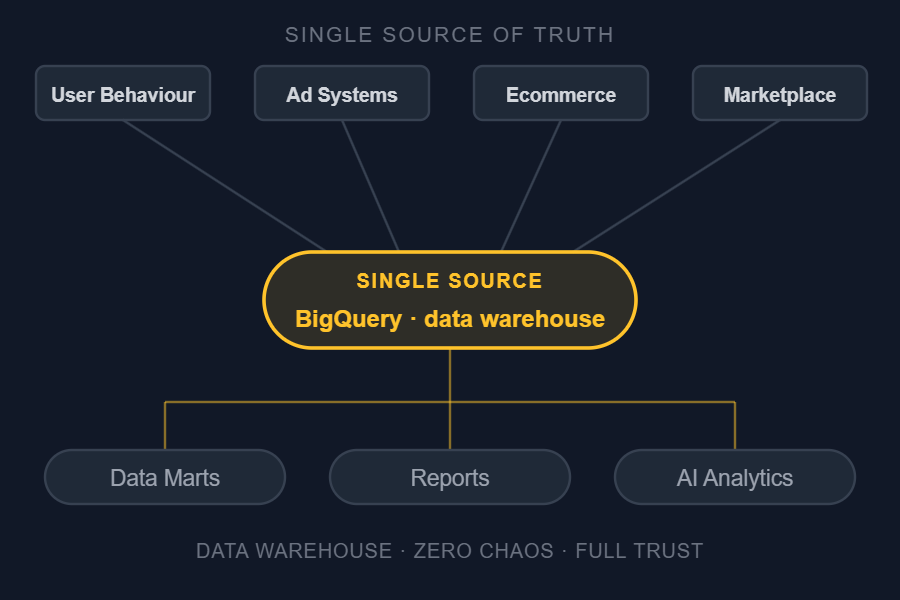
All In One is our module in the WitCloud platform. In one place it gathers all your data — from your store, ad systems, analytics and marketplaces — and organizes it into ready-to-use sets you can read answers straight off. It sounds simple, but it's exactly this order that decides whether you make decisions from your data in minutes or in weeks. Let's start with the problem All In One solves.
You have data everywhere — answers nowhere
“What was our actual ROI last quarter?” — a seemingly simple question that very few people can answer off the top of their head. The data is right there: in GA4, Google Ads, Meta, the e-commerce platform, on the marketplace. And yet, to calculate a single number, someone has to pull it out of every system separately, stitch it together, reconcile the names and clean it up.
Some companies still do it the old way — an analyst glues a report together in a spreadsheet for a week, or everyone waits until the end of the month for the “results to come in,” and only then makes decisions. Some, in 2026, do it in a more modern way: they connect AI directly to their systems — GA4, Meta, the store — via MCP, for example, and ask the model to assemble the report itself. And it works — up to a point.
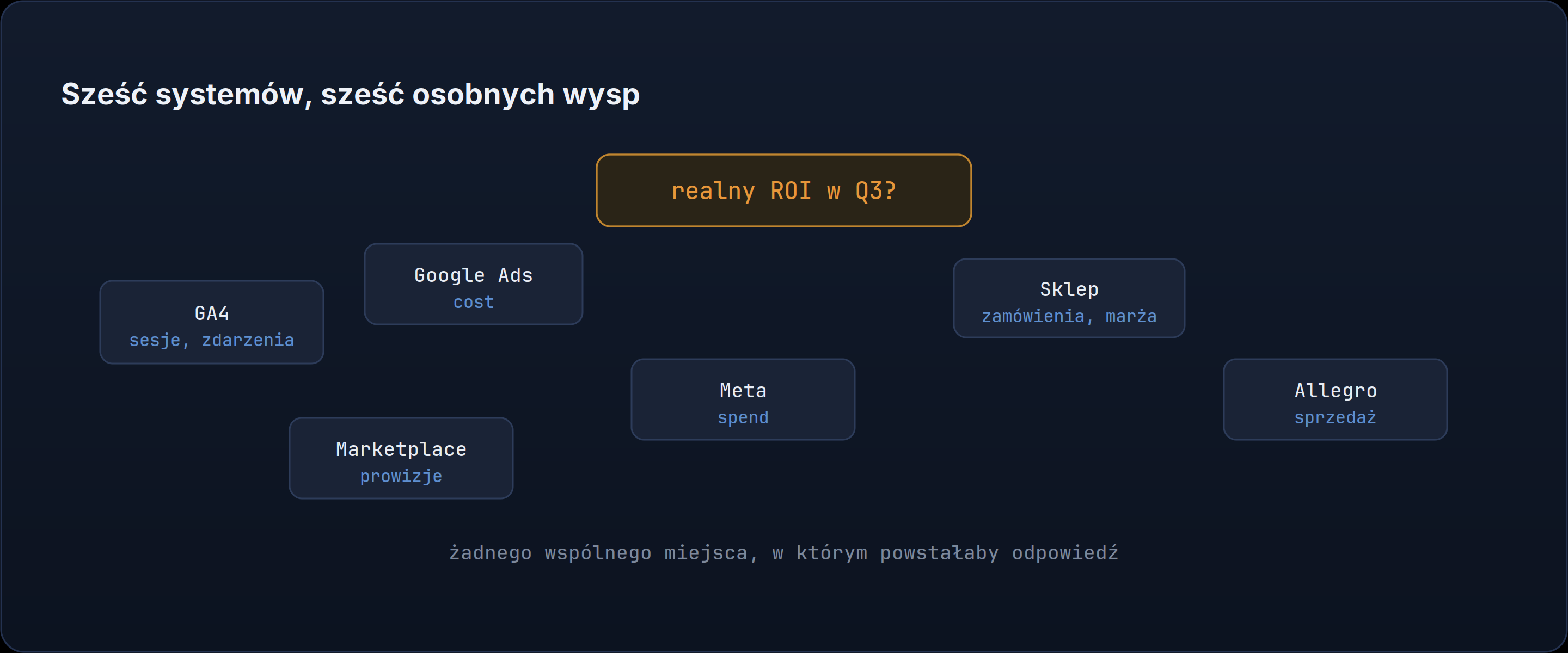
Every system holds its own piece of the truth — and its own naming. As long as they sit apart, a simple number takes manual stitching every single time, from scratch.
Because the problem doesn't disappear when you plug in AI — it just moves. Raw, scattered data is just as hard for the model as it is for a human: to calculate anything, the AI queries six sources, pulls thousands of raw rows about products and transactions into context, fires off query after query — and on larger datasets it simply chokes. It answers slowly, expensively and unreliably.
So the problem lies neither in a lack of data nor a lack of tools. It lies in the fact that the data is scattered and every source speaks its own language. Gathering it in one place is only half the journey.
Gathering the data is half the journey. Organizing it so you can read answers straight off it — that's the second half, and the more important one.
First, everything in one place — and it's yours
The first step is mundane, but everything starts with it: All In One brings all your sources — store, ads, analytics, marketplace — together in one place and refreshes them automatically. No more manual exports, no more “yesterday's data.”
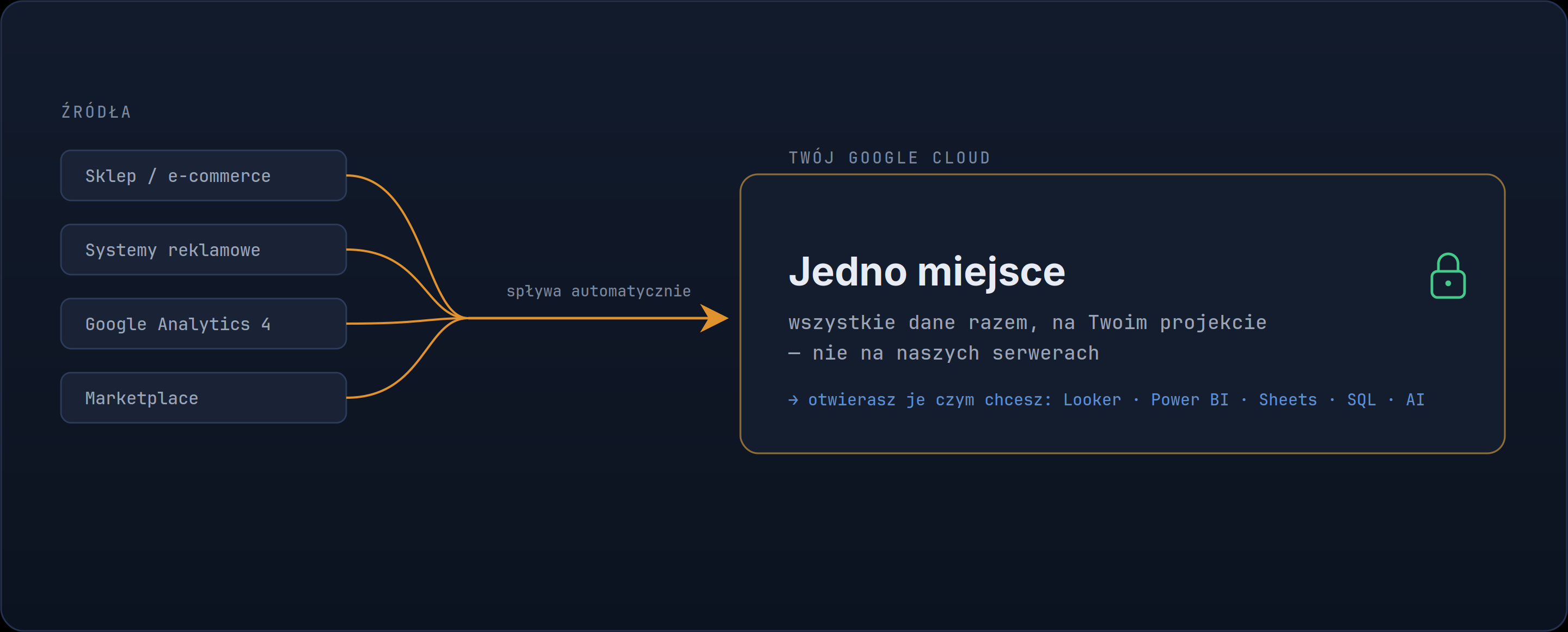
The warehouse sits on your own Google Cloud project, not on our servers. The data is and stays yours — with full control and ownership.
Where that place lives matters. The warehouse sits on your own Google Cloud project — not on our servers. The data is and stays yours: you have full control over it, full ownership, and the certainty that it isn't locked in with an external vendor that's hard to detach from later.
And since it lives in your BigQuery, you open it with whatever you like — Looker Studio, Power BI, Tableau, Google Sheets (Connected Sheets), your own SQL or AI tools. No re-plugging, no exports, no waiting on us. This isn't a legal detail — it means you're building your own asset that stays with you regardless of who you work with, and that nobody can switch off on you.
From raw tables to ready answers
Gathering data in one place doesn't yet mean it's ready. A raw API export isn't an answer to a question — it's the raw material you still have to compute the answer from. And the material from every system looks different.
The simplest example: Facebook calls the money spent spend, Google calls it cost. It's exactly the same thing — advertising cost — but until someone brings it down to a common word, the two systems refuse to add up. All In One does this automatically: both become a single metric — ad_system_cost. And there are hundreds of such mismatches: different names, different date formats, different currencies, different conversion definitions.
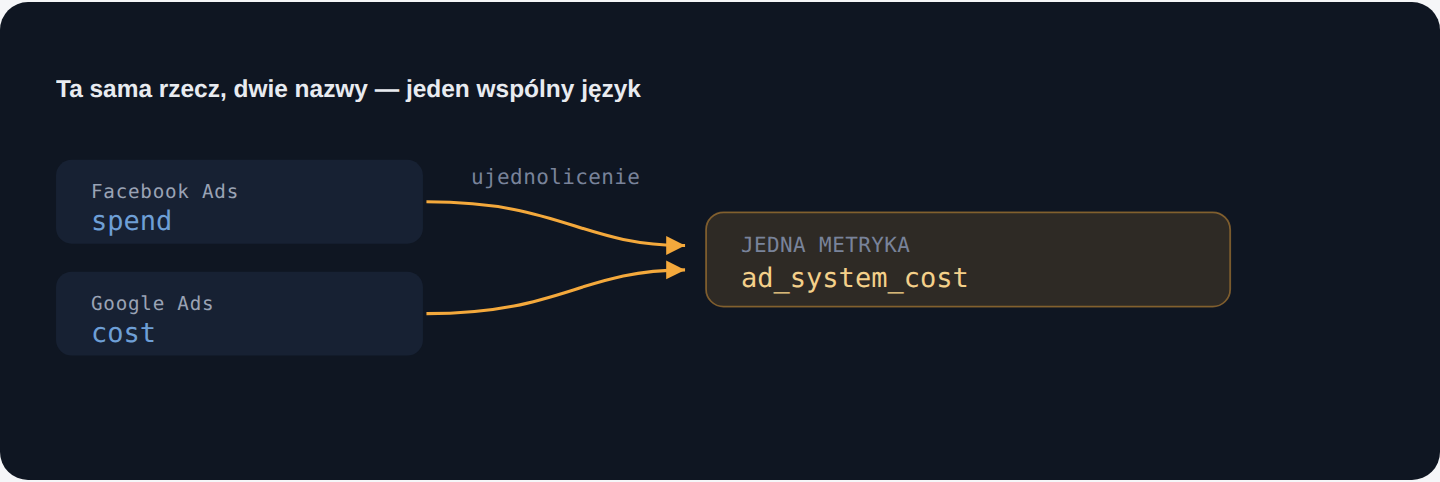
Advertising cost is advertising cost — no matter whether a system calls it spend or cost. Unification brings hundreds of such mismatches down to one consistent model.
This is exactly what All In One's whole job is: it brings all your sources down to one common language, and then builds ready-made datasets (datamarts) from them, arranged around real business questions. Instead of dozens of raw tables you still have to join, you get ready-made views:
- ad_systems — all costs, clicks, impressions and conversions from ads in one consistent view.
- orders — hard sales from the store combined with marketing costs; here you calculate ERS, ROI, new vs. returning customers.
- orders_products — sales at the level of a single product: what sells, what earns, how it changes over time.
- ga_sessions — traffic and behavior from GA4 combined with ad costs, i.e. blended ROAS for each channel.
- ga_orders, ga_attribution_paths, ga_attribution_summary — sales and multi-channel conversion paths for attribution analysis and budget allocation.
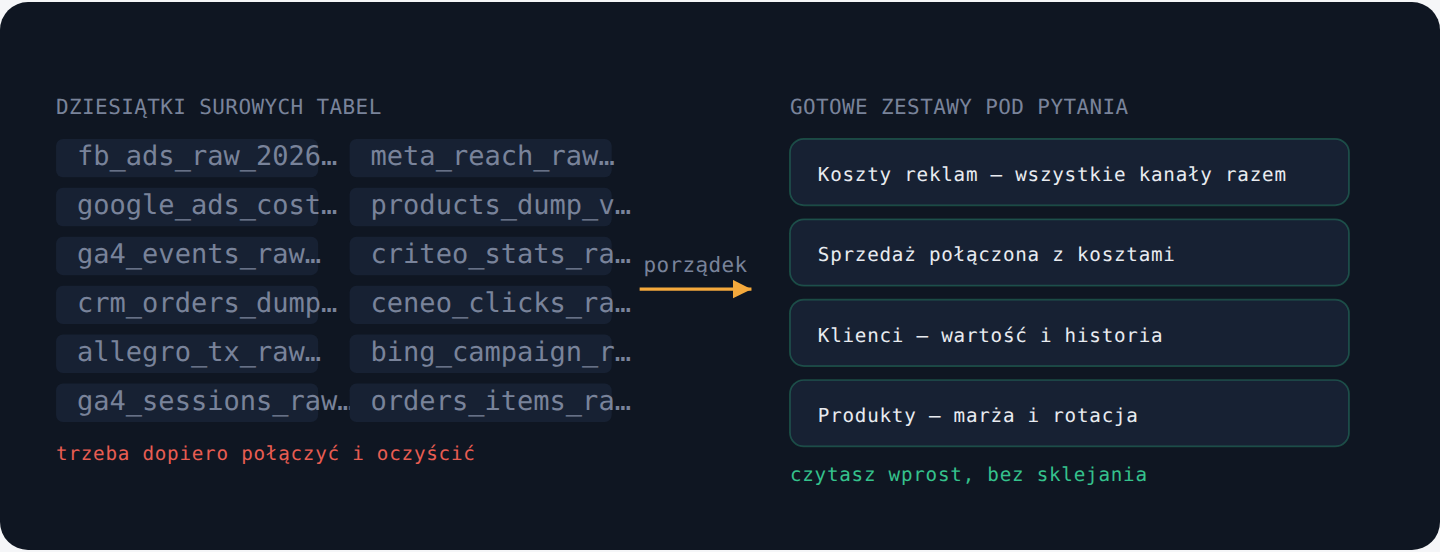
The difference is like between a warehouse full of parts and a finished car. Both “contain” the same thing — but only one of them you can actually drive away.
And all of it tied together from one place, no matter how many tools you use today for ads and sales:
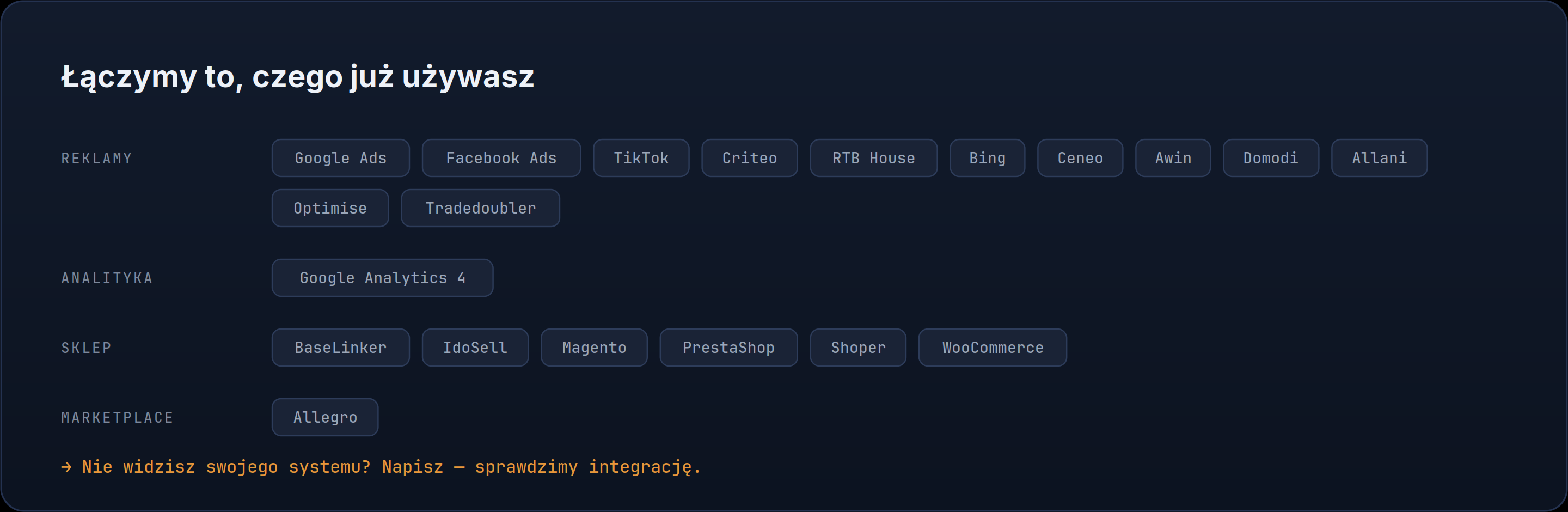
The question “what was our actual ROI last quarter” then stops being a week-long project. It becomes something you simply read off.
Only now does AI have something to work with
Let's come back to AI, because this is where it all comes together. What wears down an analyst stitching data together wears down the model too — with the difference that the model won't tell you. Thrown at raw, scattered tables it does exactly what we described at the start: it multiplies queries, pulls huge, disorganized sets into context, confuses spend with cost, computes slowly, expensively and with no guarantee it's right.
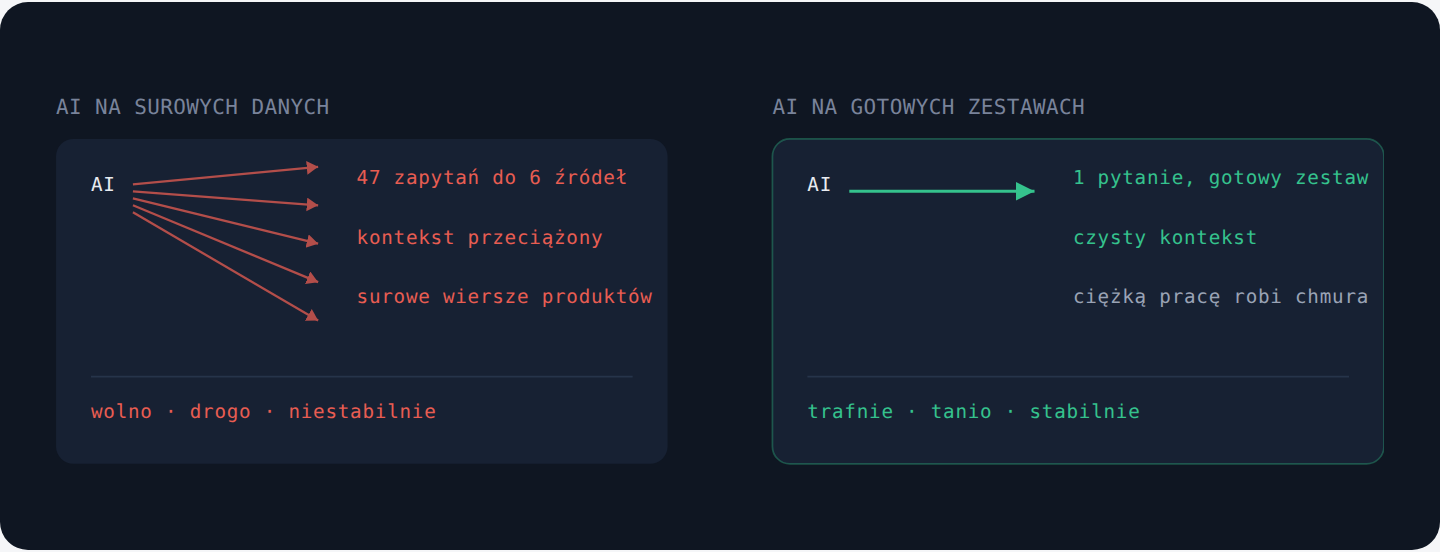
On the left, AI on raw data: many queries, an overloaded context, unstable results. On the right, on ready-made sets from All In One: one question, a clean context, an accurate answer.
Once it's organized, the setup flips. The heaviest lifting — joining, cleaning and aggregating millions of rows — All In One does earlier, in the warehouse, on Google Cloud's compute power. So the AI doesn't have to grind through raw tables: it asks for a ready, lightweight set and gets an answer right away. The context stays clean, the queries cheap, and the model does what it's genuinely good at — it analyzes and suggests action, instead of fighting the data format.
Lay the foundation and organize your data — get in touch
A single source of truth isn't a convenience for the people doing the reporting. It's the precondition for everything that comes next. All In One arranges the data once, and the whole WitCloud platform gets a solid, clean base — along with the next modules you run on it: KPI monitoring, customer segmentation, product analysis, an AI assistant.
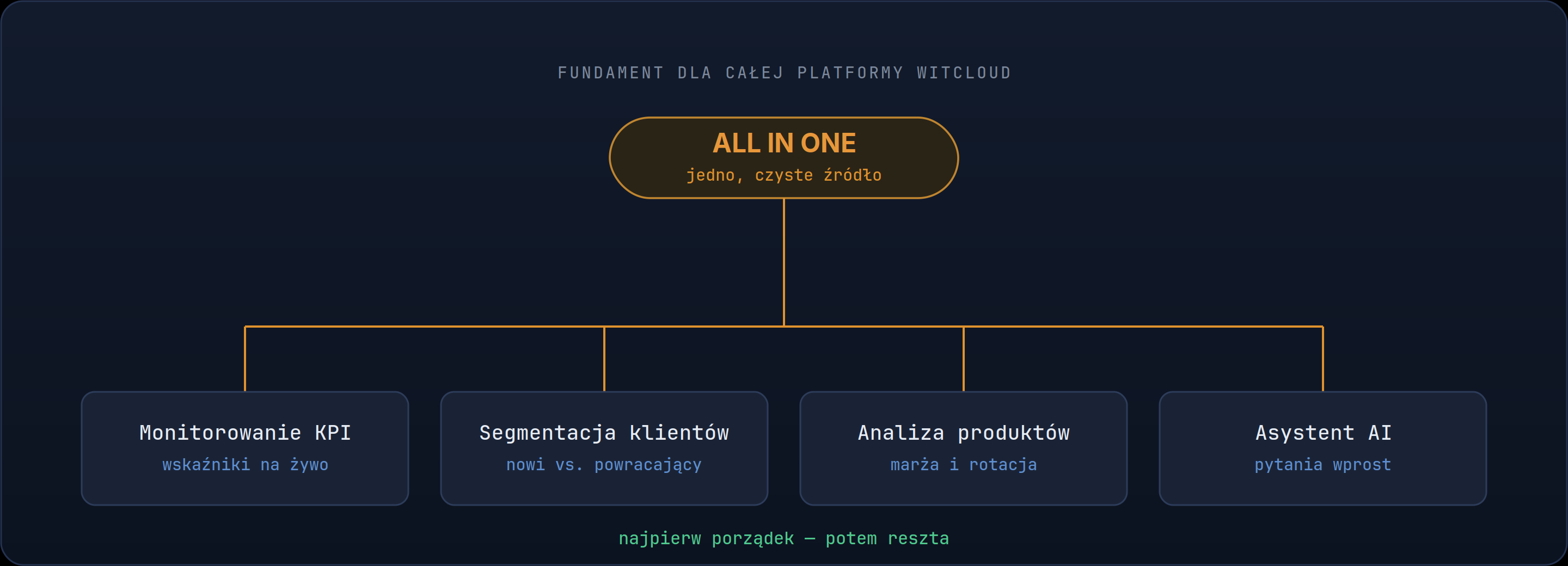
All In One arranges the data once — and every next module of the platform gets a ready, clean base.
And here's the crux. A well-designed, organized dataset lets you move quickly from questions to action: segment customers, analyze product profitability, ask the AI assistant straight out — without a week of stitching reports together and without guessing whether the numbers add up. All In One takes on the hardest part: gathering the data in one place and bringing it to a common language. What's left on your side is just decisions.
The best moment to lay that foundation is now — and the easiest way to start is a short conversation with us. Instead of fighting your data — manage it.